Posts Tagged ‘linda hubalek’

Books, Books the Magical Fruit Interview about Linda Hubalek

Written by lindahubalek on . Posted in about Trail of Thread book series, Blog, Butter in the Well book series

I enjoy book bloggers  interview questions, because they really come up with some good ones. Here’s some of my answers from a recent blog site called “Books, Books the Magical Fruit.” The blogger read and reviewed the book Trail of Thread too.

(Want to review or blog about my books for your blog? Please send me an email!)
Pioneer Writer, Linda K. Hubalek

Describe your book in five words or less.

Endearing Kansas pioneer women stories.

How did the ideas for your books come to you?

I started writing books in 1992 when my husband was transferred to California for a two-year engineering project. I was homesick for the Midwest and started writing about the Swedish immigrant woman that homesteaded our family farm.

What is the hardest part of writing for you? What’s the easiest?

Hardest part? Getting started and staying focused. Easiest? I love the research and reading about that time period that my books are set in.

What’s next for you? Are you currently working on or have plans for future projects?

Currently I’m working on my fourth book series, the Kansas Quilter, featuring my great grandmother Kizzie (Hamman) Pieratt. Born in 1874, Kizzie grew up in a large family in the Flint Hills of Kansas. She married Ira Pieratt in 1894 and had eight children over a twenty-year span.

The Pieratt family was featured in my Trail of Thread series, so the Kansas Quilter series will continue their original story into the next generation of characters.

Kizzie was known for her quilting. I’m sure at first it was a necessity to keep her brood warm, but she also completed quilts for other people for an income. As I research and write this series I’m taking a closer look at the family quilts that my great grandmother made during her ninety-seven years.

I’ll piece together Kizzie’s stories and photos and post them in my blog and in the finished books. Look for the first book, tentatively titled Tying the Knot in the late fall of 2011.

Why did you choose to write for specific genre?

All my series have been based on real people, places and the events that went on during their lifetime. It’s a good way to get the research and story started, and it has become my chosen genre.

What’s it like hearing that readers are eagerly awaiting your book’s release date?

That’s what keeps me pumped up, knowing that someone out there appreciates the research and time put into writing my books. And it means I’ve touched their hearts with my words, and maybe lead them to understand the lives of their own ancestors too.

What is one question that you’ve always wanted to be asked in an interview? How would you answer that question?

What does your family think of you writing books? Of course my family is proud that I’m a published author, but also proud of the ancestors and farms featured in my series. My parents still live on the original farm portrayed in my first series, Butter in the Well. Because I put township maps in the books (and the roads are still the same) they know when a reader has found their farm. A car slowly drives by to look at the old house and barn featured in the series.

Where can readers find you and your books?

Go through my website, www.LindaHubalek.com to find all the links for ebooks and print books.

Review for Trail of Thread: I have to say this was a wonderful book – Little House for grown-ups. The letters tell the story of leaving for the unknown prairie and what goes on. I found each letter more enticing than the last to see where the journey would take them. I like that there are quilts that help tell the story also. The patterns are part of what goes on and the materials used are always relevant to the purpose of the quilt.

I would definitely like to learn more about what goes on once they arrive. I see this as being a wonderful series of books. Write on!- Reviewer Sue Fitzpatrick

Rose of Sharon Quilt

Written by lindahubalek on . Posted in about Trail of Thread book series, Blog

www.prairiewildflowers.com

Prairie Wild Rose

One of my passions is flowers, especially the prairie flowers that grow on their own in pastures, just blooming for themselves. My college degree was in horticulture and I spent many years in the flower and plant research industry before “returning to the prairie” myself with my living and writing.

Wild flowers have grown across the Kansas prairie and the Great Plains of North America since the start of time. Dots of color from the prairie plants wave with the green sea of grass during spring and summer. Their seed pods turn color in the fall and disperse their seeds to start another cycle of colorful and useful flowers.

Pioneer women used the prairie flowers as an inspiration for their quilt patterns, and I’ve mentioned them in my historical fiction writing.

Here’s a quote from my Trail of Thread book:

“Ann has quilts tops and quilts of her own along. It’s customary to make a baker’s dozen of quilt tops for a young woman’s dower chest. When the wedding is about to take place, the neighborhood women get together and help finish them. Ann has gone ahead and quilted three of them since she’s nearing the spinster age, but she saved her appliqued Rose of Sharon top for her wedding bed, just in case she’s proposed to yet.”

Think of the ideas and color schemes the pioneer women would have seen as they walked along the trails. And, they would have varied from state to state and the time of year. I think it would help the walk to concentrate on the beauty of nature and how it could be used in a future quilt.

Harvesting Faith

Written by lindahubalek on . Posted in Blog, Planting Dreams book series

Photo by Linda K. HubalekCombines are running full blast to get the wheat harvested before the next storm blows into the state. Rain is good for the row crops (milo, corn, and soybeans are grown in our area), but not when you need to get the wheat harvested.

Not only must the combines manuver through the field without being stuck in mud, big trucks must drive next to the combine in the field while the wheat seed is augured out of the combine bin into the truck’s bed.

Then what happens to this grain? The loaded truck drives to a nearby grain elevator to unload the wheat, and then back to the field for the next load. Eventually semi-trucks will move the wheat from the storage elevators to rail cars or ships to travel where it will be used. This Kansas wheat might be in your next loaf of bread or bowl of pasta, whether you live in the United States or overseas.

It takes a lot of hard and fast work—and faith—that you’ll get the wheat cut while it’s at the right ripe stage. Hail can break the straw stems so that it can’t be cut, or continuing rain can cause the wheat seed to sprout while the plants are still standing, and ruin it.

Farming is always a gamble but it seems to be intensified during wheat harvest. No forty-hour weeks now. The combine is running continually until the straw is too tough to cut—which could be anywhere from 6 pm to 1 am. During the downtime (early mornings) machinery needs to be repaired and maintained, besides whatever else needs to be done on the farm.

Uprooting their families and moving to Kansas was a gamble for the Swedish immigrants too, just like wheat harvest. The Planting Dreams series (with Harvesting Faith being the third book) is dedicated to the people that homesteaded on the Kansas prairie to make their living by farming.

After 142 years from my immigrant ancestor’s arrival, my family is still farming and harvesting wheat today.

Welcome Summer

Written by lindahubalek on . Posted in Blog, Butter in the Well book series, Planting Dreams book series

Festival in Little Sweden USA- Lindsborg, KansasIt’s felt like summer for over a month with our high temperatures and Kansas winds sweeping across the Plains, but now it’s officially here. Thunderstorms are part of the season and they have already been a mainstay this month too. Luckily we’ve had rain, but no damage in our area.

Our little community of Lindsborg, Kansas (known as Little Sweden USA) celebrated the start of summer this last weekend with our 40th annual Midsummer’s Day Festival. The Smoky Valley region of Kansas was settled by Swedish immigrants in 1869 and the heritage of the original homesteaders is still honored in our area today.

Saturday’s celebration included the raising of the maypole, dancing, food, and heritage exhibit booths. We had a heck of a storm with hail, wind, and rain the night before, but Saturday was perfect weather for the festival.

I often wondered while researching and writing both the Butter in the Well and Planting Dreams series what the Swedish immigrants thought of their first full-blown thunderstorm while out in the middle of the Kansas prairie. It’s quite a sight as the clouds mushroom in the big sky and then grows black as it barrels toward you. That’s when a dugout would have been a good place to be….

Välkommen Till Kansas sommar!

Great review from Tina "The Book Lady"

Written by lindahubalek on . Posted in about Trail of Thread book series, Blog

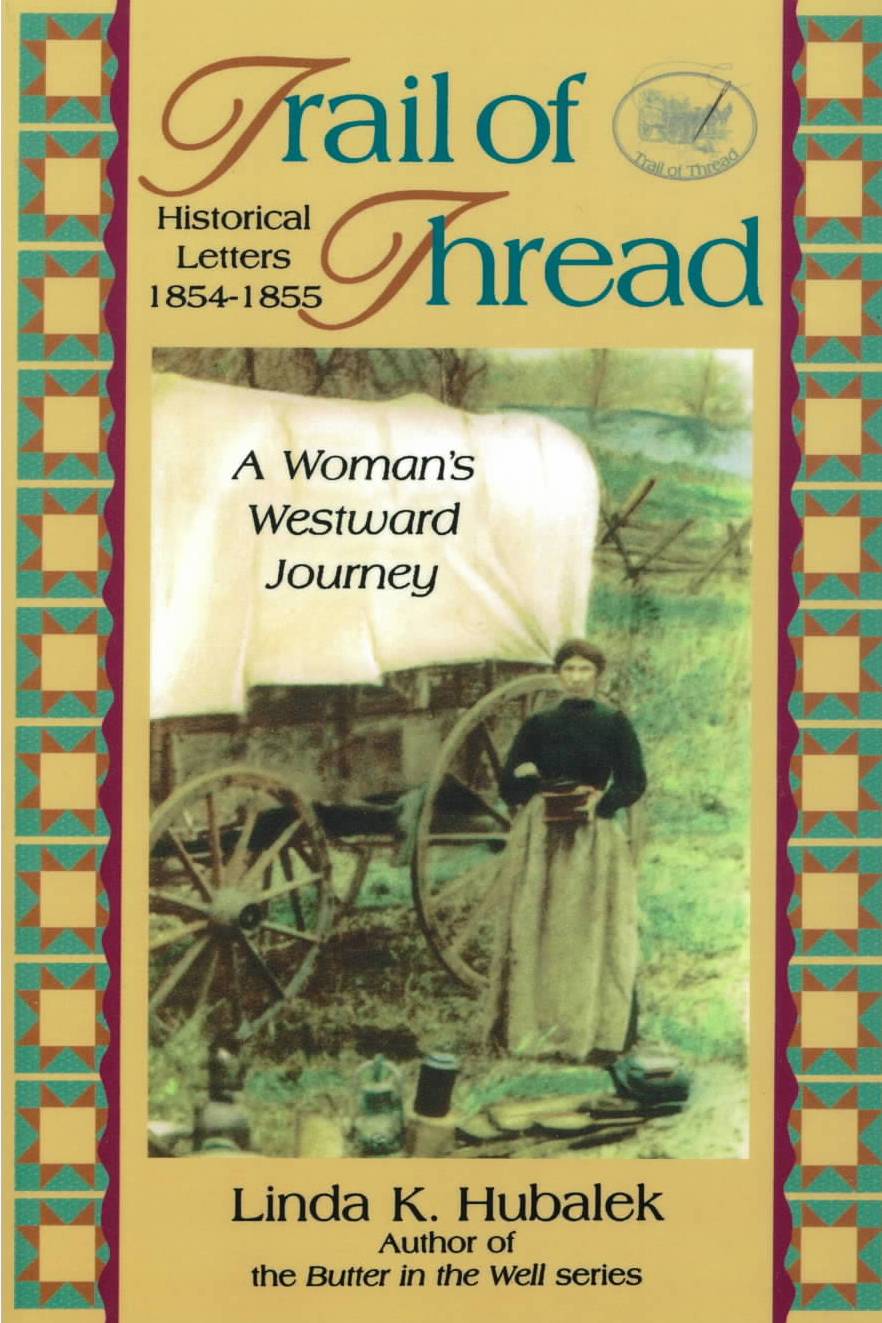
The Trail of Thread book series got a great review from Tina, “The Book Lady” on the Family and Literacy and You website today.

Pioneer woman's story by Linda K. Hubalek.“I thoroughly enjoyed Deborah’s story as she and her family traveled to their new home in the Kansas Territory. Written as a series of letters from Deborah to her stepmother who raised Deborah and her siblings you learn about the trials she and her family went through during the journey to their new home in the new Kansas territory in 1854. Deborah shares everything in her letters – her emotions, her triumphs, her worries and sorrow as another family loses everything they own (can you imagine?).

The Trail of Thread series is a set of 3 books and is the story of the author’s mother’s ancestors. Very well researched (she includes the Bibliography in the back of the book) and well written it’s easy to image the sheer amount of work Deborah went through to prepare for the journey, from sewing the canvas for the wagon top, making sure it was waterproof, packing the wagons, deciding what to take, what to leave behind and more. You’ll also “feel” the emotions of wondering and planning in case something happens to your family. Will everyone survive the trip?

The book is a quick very enjoyable read and you’ll definitely want to read the 2nd and 3rd books in this series. Imagine the Little House on the Prairie books but written from an adults perspective. Share these books with your family. Read them aloud and talk about what it would be like to ride in a covered wagon, to walk across the states instead of taking a 10 hour car ride to get where you want to go. These books would also be great for kids that need to write a report for history class – the research and the writing will help them prepare for a top notch report. They’re perfect for everyone age 9 – 99!”

Ebook Sale on Planting Dreams Series

Written by lindahubalek on . Posted in Blog

In honor of Father’s Day, three ebooks will be on sale for $3.99 for a month at only two sites, Amazon and Barnes and Noble. You can either download them for Kindle or Nook. Get them now and enjoy!

Planting Dreams Series- Historical Fiction About Pioneer Families

My third book series is based on my father’s Swedish ancestors who came first to Illinois, and then on to Salemsborg, Kansas in 1869.
Charlotta’s thoughtful writing covers the time period of 1868-1919 and tells why the Swedish immigrants decided to leave, their journey, and their life on the Kansas prairie.

This book series is based on stories and photos from Johnson descendants, along with fiction depicting Kansas history during this time period.
 

Planting Dreams: A Swedish Immigrant’s Journey to America
Book 1, 1868-1869

Planting Dreams book by Linda K. HubalekDrought has scorched the farmland of Sweden and there is no harvest to feed families or livestock. Taxes are due and there is little money to pay them. But there is a ship sailing for America, where the government is giving land to anyone who wants to claim a homestead. Can you imagine starting a journey to an unknown country, no knowing what the country would be like, where you would live, or how you would survive? Did you make the right decision to leave in the first place?

For more information and how to buy the Planting Dreams ebook or book>>>

Cultivating Hope: Homesteading on the Great Plains
Book 2, 1869-1886

Cultivating Hope book by Kansas author Linda K. Hubalek.Can you imagine being isolated in the middle of a treeless grassland with only a dirt roof over your head? Having to feed your children with whatever wild plants or animals you could find living on the prairie? Sweating to plow the sod, plant the seed, cultivate the crop- only to lose it all by a hailstorm right before you harvest it?

The second book, in the Planting Dreams series portrays Swedish immigrant Charlotta Johnson as she and her husband build a farmstead on the Kansas Prairie.

For more information and how to buy the Cultivating Hope ebook or book>>>

Harvesting Faith: Life on the Changing Prairie
Book 3, 1886-1919

Harvesting Faith book by Linda K. Hubalek.Imagine surveying your farmstead on the last day of your life, reviewing the decades of joys, hardships, and changes that have taken place on the eighty acres you have called home for the past fifty years. Would you feel at peace or find remorse at the decisions that took place in your life?
This third book in the Planting Dreams book series portrays Charlotta Johnson as she recalls the events that shaped her family’s destiny.

For more information and how to buy the Trail of Thread ebook or book>>>

When Family History Inspires You to Write Fiction

Written by lindahubalek on . Posted in about Trail of Thread book series, Blog

In 1990 my husband had a two-year engineering project that required us to move to the San Francisco area. I sold my wholesale horticulture business because it wasn’t something I could maintain from out of state.

Searching for what I wanted to do while in California, I decided to look into my ancestors past as a project to work on. I researched and found my family’s history, not only the important dates of their lives, but also their stories.

What I realized is that all my ancestors traveled from other places to settle in Kansas when the territory opened up in 1854, or shortly after the Civil War when land was available to homestead. They were from European countries, leaving family, community and the life they knew behind to start a new and hopefully better life In America.

The history that my family just happened into, because of the state and nation’s situation, inspired me to write the Trail of Thread series. To give them a personal feel, I wrote the stories in the form of letters sent back home to loved ones.

For example my ancestors Deborah and John Pieratt (with six children along), featured in the first book of the Trail of Thread series left Kentucky in 1854 when the Territory of Kansas was formed. They were part of the thousands of families that packed wagons and headed west for the promise of a new life. My mother, uncle and I actually drove their trip—by car in a few days—to see what they would have seen in person.

Thimble of Soil, the second book in the series, features a great aunt Margaret Ralston Kennedy. She was a widow who moved with eight of her thirteen children from Ohio to the Territory Kansas in 1855. I found out by research that she helped with the Underground Railroad in both Ohio and Kansas!

Orphaned Maggie Kennedy, my ancestor portrayed in Stitch of Courage, the last book in the series, followed her brothers to Kansas as the states fought out the history of the Civil War. She found love with Deborah Pieratt’s son and gave birth to the great grandfather I knew.

Not only did this information give me a look into my ancestors’ life and times, it inspired me to write books to give readers a “slice of life” of my ancestors, and all people that lived through this time period.

I hope you’ll read the Trail of Thread series to get an insight into your family’s history too.

Planning a Move in 1854

Written by lindahubalek on . Posted in about Trail of Thread book series, Blog

Pretend your husband—or father—decided to leave the home you’ve always known and you’ll be traveling through several states to a new territory he heard about. It’s the nineteenth century and you may not even a paper map to guide your family to this new free land—but he is determined to start a new farm in some wild land behold civilization.

My ancestors, John and Deborah Pieratt—with six young children along—left Kentucky in 1854 to move to the new Territory of Kansas. Their journey was the basis of my book Trail of Thread, which was written in the form of letters that Deborah wrote and mailed back to family in Kentucky. Deborah describes what she saw, and what their family experienced on their three-month journey.

The family had to carefully plan first so they would be prepared for the journey, and for the wilderness land they would eventually homestead on.

Pretend you want to prepare for this journey as a class or family project.

What—and how—do you pack in the four by ten foot wagon for a family of eight? (And what do you need for your trip to begin with?!) How much weight can the wagon hold and the oxen (or horses or mules) pull?

How long will the trip take? What will be your route? What roads (or rough trails) will you use and what towns will you be traveling through?

How will you cross rivers with your wagon? Is there any rough terrain along the way that may make the trip hard and dangerous?

How much food should you pack? How do you keep it from spoiling?

When you’re done researching the trip preparation and route, look for stories from old newspaper clippings of what was going on in the Territory of Kansas during 1854-1865. The Pieratts settled in an area and time frame known as the Bleeding Kansas conflicts due to the tension mounting about the slavery issue that exploded into the Civil War. (You can read more about these conflicts and how it affected the family by reading the rest of the Trail of Thread series, Thimble of Soil and Stitch of Courage.)

I brought the Pieratt’s story to life in the pages of Trail of Thread. Now can you plan your own trip in 1854?

The Meaning of Quilts

Written by lindahubalek on . Posted in Blog

Thimble of Soil, Book 2 in the Trail of Thread book series.By definition, a quilt is a coverlet or blanket made of two layers of fabric with a layer of cotton, wool, feathers, or down in between, all stitched firmly together, usually in a decorative crisscross design. The top layer may be a single piece of fabric, or it may be a made from a variety of scraps of material that were pieced together to form blocks, that are then sewn together to make the top layer.

When one thinks of pieced quilts, pioneer women automatically come to mind. This group of women often had to move, start new households, and work with what they had on hand. Their quilts would have been used daily, made and patched to last through the rigors of pioneer life.

Pioneer woman's story by Linda K. Hubalek.For example Deborah and John Pieratt, featured in the first book of my Trail of Thread series, left Kentucky in 1854 when the Territory of Kansas was formed. They were part of the thousands of families that packed wagons and headed west for the promise of a new life. Quilts would have been used for bedding—in the wagon or on the ground, as a hanging shelter, or as a partition for privacy. They were also used for burial of loved ones along the trail.

Thimble of Soil, the second book in the series, features Margaret Ralston Kennedy. She was a widow who moved with eight of her thirteen children from Ohio to the Territory Kansas in 1855. She was dedicated to the cause of the North, and helped with the Underground Railroad in both Ohio and Kansas. It is possible that some of the quilts she made had special blocks giving direction to runaway slaves.

Stitch of Courage, Book 3 in the Trail of Thread book series by Linda K. Hubalek.Orphaned Maggie Kennedy, portrayed in Stitch of Courage, the last book in the series, followed her brothers to Kansas looking for a better life as the states fought out the history of the Civil War. Women made and gave quilts for the soldiers to use during their journeys and battles.

What was the meaning for all these quilts? They were all just fabric to provide warmth and protection, but they also connected the hearts and souls of the past, present, and future.

The young woman on the trail packed quilts to use, but also to bring memories of her family left behind to her new frontier home.

The older woman—who stitched directions in her quilt that hung outside to air— gave freedom to people trying to escape a bad life.

The soldier wrapped in a dirty quilt, trying to keep warm and get a bit of sleep, was given the security of knowing that someone from home was thinking of him and waiting for his return.

Think of the countless hours of work and devotion it took to create these pioneer quilts. These finished masterpieces of the fingers gave a sense of accomplishment to the makers, and comfort and connection to the users.

Do you have a special quilt passed down through your family? What does it mean to you?

Author Interview by Caroline Clemmons

Written by lindahubalek on . Posted in about Trail of Thread book series, Blog

(Caroline Clemmons interviewed me for her book review blogspot. She posted an excerpt from my book, Trail of Thread too. Please enjoy both.)

Caroline: Readers love to get to know authors. Share anything that lets readers get to know the real you.

Linda: I grew up on a wheat farm in central Kansas. This farm was featured in my Butter in the Well series, and my parents still live there. I was a shy tomboy who preferred being outdoors, and working with animals, farming or gardening—rather than being inside doing housework and cooking. (And my husband would say I’m still that way.)

I have two older brothers and a younger sister and we were all involved in 4-H, church and community projects growing up. One brother now farms the family land and the other two live out of state. My husband and I have lived in three other states due to job careers, but then moved back to Kansas in the 1990s to be close to family.

Caroline: Who are your favorite authors and favorite genres?

Linda: When I read books, it’s right before bedtime so I want something fun, romantic, and not something that will give me nightmares. Right now I’m into contemporary western romances.

Caroline: How many books do you read a month? What are you reading now?

Linda: Depending on the time of year, I read from two to eight books a month. I seem to have a “Linda” theme at the moment…as I’ve been reading Linda Lael Miller’s and Linda Warren’s books.

Caroline: Can’t go wrong there. When you’re not writing, what’s your favorite way to relax and recharge?

Linda: Reading in a quiet room with a nice stash of chocolates…or out walking….off those chocolates…

Caroline: Can I stay behind with the book and chocolates? 😀 Would you like to share any guilty pleasures that feed your muse?

Linda: Chocolates and chocolate ice cream is my guilty pleasure…for any reason!

Caroline: Me, too. How long have you been writing?

Linda: I started writing books in 1992 when my husband was transferred to California for a two-year engineering project. I was homesick for the Midwest and started writing about the Swedish immigrant woman that homesteaded our family farm.

Caroline: Where do you prefer to write? Do you need quiet, music, solitude? PC or laptop?

Linda: I write in my office with my big computer monitor and curved keyboard attached to my laptop. It’s got to be absolute quiet for me to concentrate so nobody can be in the room with me.

Caroline: Are you a plotter or a panzer?

Linda: Do I plan ahead or charge my way through life or writing? Depends on the day and the situation!

Caroline: I always ask here if you use real events or persons in your stories, but I know that you do.

Linda: All my series have been based on real people, places and the events that went on during their lifetime. It’s a good way to get the research and story started.

Caroline: I was impressed with evidence of your research for TRAIL OF THREAD. Do you research before you begin a new project, or as you go along?

Linda: I start out with lists of ideas first, then research, then outline, then start expanding the chapters—combining everything I’ve absorbed in the process.

Caroline: Tell us about your writing schedule. Do you set goals? Do you write daily?

Linda: My day depends on life…and aging parents’ doctor’s appointments right now. I don’t set goals like I used to as something unforeseen can change and then just makes life stressful. I write something every day and sometimes at night in my dreams too.

Caroline: Yes, family comes first. Do you write full time or do you have a day job. If you have a day job, what is it?

Linda: I’m just getting back to full-time writing. We started raising bison in the 1990s and we ended up opening a Visitor Center on our farm because we had so many people coming in for tours. But both us— and the buffalo herd—were getting tired of tourists and being open seven days a week, so we closed it last year to get our lives back to a more normal pace.

Caroline: I love that you use your ancestors as souces. What do you hope your writing brings to readers?

Linda: I hope my writing gives readers a sense of their ancestors’ lives, and to maybe search out their own ancestors’ stories.

Caroline: What advice would you give to unpublished authors?

Linda: Now you can publish your work by yourself on the internet if you don’t want to look for a publisher, but please be sure to protect your book as best you can with an ISBN, copyright date, etc. You can learn how to do all of this through the internet.

Caroline: Tell us about TRAIL OF THREAD.

Back cover blurb: Taste the dust of the road and feel the wind in your face as you travel with a Kentucky family by wagon trail to the new territory of Kansas in 1854. Find out what it was like for thousands of families who made the cross-country journey into the unknown.

In this first book of the TRAIL OF THREAD series, in the form of letters, Deborah Pieratt describes the scenery, the everyday events on the trail, and the task of taking care of her family. Stories of humor and despair, along with her ongoing remarks about camping, cooking and quilting make you feel as if you pulled up stakes and are traveling with the Pieratts too.

Excerpt from Trail of Thread: January 24, 1854 . . .

I don’t usually pay attention when the men talk about politics, but I automatically listened while I laid the dishes of food in front of them. They were discussing the new government bill that proposes to open up prairie Indian land, west of Missouri, to white settlement. A bill called the Territory of Platte failed last spring due to Southern opposition. Now an amended bill, breaking up the land into two sections, the Territory of Nebraska and the Territory of Kansas, is being discussed. Problems of slavery being legal in the new territories are being hotly debated between the Northern and Southern states. It sounds like the government has determined that the people who settle the territories can decide whether they want to allow slavery in their new states.

The traveler carefully pulled a folded newspaper clipping out of his front jacket and handed it to John. Holding it up to the candlelight, John read out loud that when the bill passes in the spring, as they predict it will, a man can claim whatever land he wants in these new territories for about a dollar an acre.

Kentucky was a wilderness in the early 1800’s, when John’s grandfather, Valentine Pieratt, moved his family from Maryland. He sailed across the sea in 1780 from France to fight in the Revolutionary War, decided to stay in the New World, and moved westward to a new wilderness whenever the area he lived in became populated.

Because land is getting scarce here for new generations, the idea of plenty of cheap land immediately stirred our men’s interest. I believe the adventure of their grandfather haunts their thinking, too.

When John finished reading that article and looked up into my eyes, I knew his mind was set to move as soon as possible. He wanted to blaze his own trail to the new territory and be ready to stake his claim when the land opened up. We are partners in life, but I knew I had no say in this move.

Today is my thirty-third birthday. Where will I be on the next? Will my children survive the trip and be around me to help celebrate it?”

Caroline: I love that–“partners but no say in this.” Where can readers find your books?

Linda: Go through my website to find all the links for book ebooks and print books.
Amazon.

Books are also available wholesale for stores, libraries and schools through http://www.butterfieldbooks.com/.

Caroline: How can readers learn more about you?

Website: http://www.lindahubalek.com/

Blog: www.LindaHubalek.com/feed/rss

Facebook: www.Facebook.com/lindahubalekbooks

Thanks so much for joining us today, Linda. Continued success with your books!