Posts Tagged ‘linda hubalek’

How Valuable is that Quilt?

Written by lindahubalek on . Posted in Blog, Butter in the Well book series, quilts and quilting

Isn’t it funny how we used “old bedding” when we were growing up, and now realize how valuable these antique quilts are due to the work and love put into each of them?

This fall I moved my parents from the farm they had called home for 65 years to a smaller home in town.

Because my parents didn’t have room for two trunks of quilts, I was lucky to inherit them. Inside these wooden chests were the handmade quilts, made by my great grandmother and grandmother, which we had used on our own beds when I was young.

My childhood years in the 1960s were spent in a wood frame house built back in 1870. This house was featured in my Butter in the Well book series. The only heat for my upstairs bedroom came from a floor vent, which let a little warmth drift up from the room below. Therefore, during the winter months, there were “blanket sheets” on my bed, plus three or four quilts on top.

Then I grew up, left home, and started using the light modern blankets on my bed.

Looking through the inherited quilts again brought back many memories. Not only of the quilts, but other flashes—like tucking my feet up inside the flowered flannel nightgown I wore to bed, pink sponge curlers, and having only my nose sticking out from under the pile of bedding.

Now I think of how I treated those quilts that we had used for everyday bedding, and am amazed that they survived.
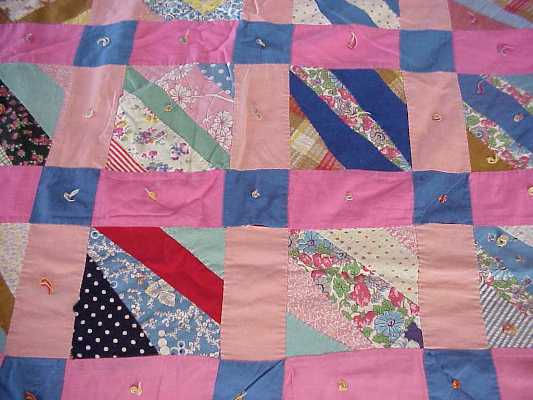
Pink quilt used by author Linda Hubalek while growing up in the "Butter in the Well" house.(Pink quilt used by Linda Hubalek while growing up in the “Butter in the Well” house)

I marvel at the thousands of tiny handmade stitches and the variety and colors of the fabric—all scraps from past clothing of my ancestors.

How many hours did the quilters spend cutting out the block pieces, and then sewing them together?

Who sat around the quilting frame to quilt them?

What was the conversation those days back in the late 1800s and early 1900s?

Did these women ever consider their handwork would keep their decedents warm after they were gone? Or that I would treasure these quilts and the memories of the quilters a century later?

Just think, whether it was a hundred years ago—or present time—a quilt made by someone’s hand, is keeping another person warm.

How valuable is that? Priceless…

(This post is currently featured on The Quilting Gallery, so be sure to read it to see more photos and enter in the contest to win an ebook copy of Butter in the Well  for your Kindle.)

The Loss of a Friend

Written by lindahubalek on . Posted in Blog, Planting Dreams book series

One of my grade school classmates died suddenly this week from some yet-unknown health issue. Eventually, after the autopsy is finished, family and friends will know what struck down the man liked by so many, but now all we can do is just wonder—and remember.

He was the class clown, often times the start of mischief in our boisterous large class of almost thirty students (all in one room those days).

In his adult life people knew him as a family man, auctioneer, their kid’s softball coach, and church leader who almost always had a smile on his face and a greeting on his lips.

At first, few in our community knew of his death because he did not live locally, then the news spread through phone calls, Facebook, etc.

While researching pioneers’ lives I’m come across situations like this where no one knows why a person died, or when it happened.

Unless it was an accident, or a known disease that was plaguing the community, an autopsy wasn’t performed on a deceased a century ago. The body was prepared for viewing at home, and then buried in a local cemetery. I found out it happened more than once to my ancestors while researching my Planting Dreams book series.

Can you imagine it happening to you along a wagon trail in the mid-1800s, with no time to stop and mourn, and knowing you would never visit that grave again?

Can you imagine receiving a black-edged envelope in the mail telling to you that your child or grandchild who immigrated to America, died months ago?

Sorrow for the one lost and the memories shared are the same whether a person died generations ago, or just recently.

It is just a sad fact of life…but at least today I can remember my friend’s smile…

The Buffalo Chip Lady

Written by lindahubalek on . Posted in Blog

Ada McColl gathtering buffalo chipsI love looking at old photos collected on historical  internet sites like KansasMemory.org. One of the most famous photos, that of a woman gathering cow chips, depicts the typical life of a pioneer woman in many people’s minds.

Here’s this woman, stuck out on the Western Kansas plains, with nothing but the flat prairie behind her—and she’s gathering dried buffalo manure to use as fuel to cook her family’s meals.

That was life for the women homesteading on the plains with no trees for fuel. Unless you lived on a river that had trees on its banks, you were pretty much out of luck. Prairie fires kept trees from foresting the Plains before towns and farms changed the landscape. So you gathered whatever you could find to burn, and people soon found out that dried manure gave a nice slow burning heat.

However, one of the interesting internet links with this photo on the Kansas Memory.org site is the story behind the staging of this picture. Yes, a young woman that wanted to be a photographer set it up. In 1893 Ada McColl posed for her camera, and her mother Polly actually took the picture featuring Ada, and her little brother Burt, (mistaken for a girl because of his clothing). You can read the whole story of the Pioneer Photographer: The Story of the Cow Chip Lady in this link (then scroll down to page 10).

I always wonder about the people and scenery in old photos, so it was neat to find the story behind this particular one. Even though Ada staged the shot, it was a common chore for many a woman on the Kansas prairie in the 1850-1870s. Ada would have used her family’s cow herd’s dried manure to fill her wheelbarrow because the buffalo herds were gone from the state twenty years before this picture was taken.

But Ada gave us more than a glimpse of how the first pioneers  scrounged for buffalo chips after a herd passed through the area. She showed the view of the endless prairie in the horizon, the taste and smell of the dirt blowing on her face from the constant wind, the dry gritty feel of the dried manure on her hands, and the weight of the wheel barrow.

That’s what I aimed to portray in my books… not only visual sights for the reader, but for all their senses as well. But, I have to admit, this picture says a lot without words…

Why were these Quilts kept?

Written by lindahubalek on . Posted in about Trail of Thread book series, Blog

Double Wedding Band quilt owned by author Linda HubalekWe had a warm sunny day this week, so I pulled out a tub of quilts I inherited from Lois, my mother-in-law. They had been stored in a cedar chest, made as a high school project by her future husband back in about 1925.

I spread a white tablecloth on the driveway and unfolded the first quilt. The double wedding band quilt is a beautiful display of color, stitching, and handwork. The intricate machine stitching alone had to take days to do. The quilt is a real work of art, in perfect shape, probably rarely used except as a display on the bed for when company came. It could have been a wedding present.

The second quilt I spread out was almost past the “thread bare” stage, faded from years of use and washings. Scraps of fabric, with no color scheme, just made from what was available. I’m sure it dates back to at least my mother-in-law’s days of growing up in the 1920s- 1930s. Researching the pattern, I’d say it is a Double Quartet quilt block pattern featured in Capper’s Weekly in 1927.

Double Quartet Antique Quilt owned by author Linda HubalekThey are both machine stitched, with no signature or date on either quilt.

Lois was a very practical, organized woman, and never seemed attached to mementos from the past. She only kept and used what she needed. So now looking at this old worn out quilt, I wonder who made it, and why did she keep it.

I’m guessing the first quilt was kept because it was a gift, and a treasure due to the workmanship. The second quilt though, even plain and worn out, must have had very special memories attached to it.

My writer’s imagination flashes through many scenarios. Was it on Lois’ bed when growing up or on her sister Helen’s bed who died when the girl was a teenager? Made by a grandmother and used by the grandfather that lived with her family. Or, was it just an old quilt used as a picnic blanket in their first car?

I’ll never know the history of these quilts since the previous owner is now gone. I’m just guessing they were kept for some special reason besides for display and warmth.

Maybe I’ll honor these quilts with new “memories” in one of my future books like I did in the Trail of Thread series …

Orphaned Quilt Blocks find a new Home

Written by lindahubalek on . Posted in Blog, quilts and quilting

Orphaned quilt block made by Irene Akers

Orphaned quilt block made by Irene Akers

I found three quilt blocks, tucked in different drawers in different dressers, when sorting for my parent’s move from the farm into town recently. I wondered when these orphaned blocks were sewn, and why they were not incorporated into a quilt.

I handed the first one to Mom, which she promptly flipped over.

“It’s hand stitched, by my mother because I recognize many of her dresses in fabric pieces.”

“Any feed sack material,” I ask?

She rubs a couple of materials between her finger and thumb. “No, all the material is from dresses.”

Orphaned quilt blocks made by Ione Johnson

Orphaned quilt blocks made by Ione Johnson

The next two blocks match in pattern, but one is blue and white, the other peach and white. Mom didn’t bother flipping them over and laughed, “I made these blocks while in grade school and never finished it”.

Yes, she spent time around the quilting frame with her mother, grandmothers, and neighbors when visiting them, but she never made a whole quilt by herself.

I now know the answer with my mother’s abandoned quilt blocks, but not my grandmother’s. But that’s okay because even if these patches of sewed together fabric never became part of a quilt, they still have a memory to pass on from one quilter to another.

Mom inherited several trunkful’s of quilts from her grandmother Kizzie Pieratt, so I guess she just didn’t need to make her own. Moreover, with WWII, family priorities and types of bedding changing, maybe young wives didn’t quilt as much in the 1940s.

Now these quilts and memories of Great Grandma Kizzie are mine to savor and share.

Is this a talent that is learned, or passed down? I guess it depends on the family. The love (and necessity) of quilts and quilting done by her mother, and especially her grandmother Kizzie did not pass on to my mother, but they did skip a generation down to me.

Because it’s the beginning of the New Year, I’m thinking about projects to start—and to finish—in 2012. Where can I put my talents to the best use, to get the most out of my time, and make something lasting that can be enjoyed by me, and others, now and in the future?

What talent and legacy are you passing on in 2012? Please let me know —and share it with your family so they know the story too!

Pick a Trail of Thread for your Christmas Gift

Written by lindahubalek on . Posted in about Trail of Thread book series, Blog

Need to finish your Christmas shopping? Or maybe start your shopping?

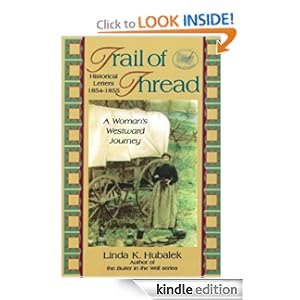
Trail of Thread (Trail of Thread Series)I heard from one reader that bought a Kindle as a gift, and was downloading books for the recipient to read right away. She had downloaded my TRAIL OF THREAD series and read them before she wrapped the Kindle in Christmas paper! Smart gal!

Remember you can “gift” an ebook to someone by just hitting the “give as a gift” button on the right side of the screen when ordering through Amazon.com. The receiver will get an email notifying them that they have a book to download onto their Kindle.

I like to read paperbacks, but ebooks are very popular so I give both as gifts.

Here’s my pioneer series that has a quilting theme to it for your quilting friends (or yourself if you get a Kindle or Nook for Christmas).

The TRAIL OF THREAD series, written in the form of letters the women have written back home to loved ones, show the thoughts, and process them went through to provide a better life not only their families, but also the state and nation during the troubling times of the Civil War.

In the first book, TRAIL OF THREAD, Deborah and John Pieratt left Kentucky in 1854 when the Territory of Kansas opened to homesteaders. They were part of the thousands of families that packed wagons and headed west for the promise of a new life. This progression leads them to own land for their family of six young children.

THIMBLE OF SOIL, the second book in the series, features Margaret Ralston Kennedy. She was a widow who moved with eight of her thirteen children from Ohio to the Territory Kansas in 1855. She was dedicated to the cause of the North, and helped with the Underground Railroad in both Ohio and Kansas. Margaret’s progression of moving fleeing slaves gave them a change for a safe free life.

Orphaned Maggie Kennedy (my great-great grandmother), portrayed in STITCH OF COURAGE, the last book in the series, traveled to Kansas looking for her brothers as the states fought out the history of the Civil War. While this might seem as a step backwards due to the times, it leads her to marriage and a family of her own.

Sound like a book series someone you know would like? Maybe this idea will finish your holiday shopping!

A Great Story is a Great Gift

Written by lindahubalek on . Posted in Blog

I got an email from another author with this headline today and I thought—this statement is so true.

The author was promoting his books for the Christmas season, and it was a good opening line.

I like the statement because the stories written in my books are gifts of insight to me—and the descendants of every pioneer that homesteaded out in the middle of nowhere.

But, the line can imply other things too.

A great story will share the history from one generation to the next. That’s a gift of heritage and pride in one’s family.

A great story may calm a child—or an adult— in a crisis. That’s a gift by preventing further trauma and frightful memories.

A great story can be seen and felt through a keepsake quilt, or through the lines of a poem, giving the gift of a visual memory.

A great story saved in one’s heart can be remembered forever—even if it was just baking Christmas cookies decades ago

This list can go on and on.

I hope today you get—or give—a great story to remember the day, or a special person by.

What’s your greatest story that was a gift to you?

The Pioneer’s Cyber Monday Sales

Written by lindahubalek on . Posted in Blog, Butter in the Well book series

While we’re ordering our holiday gifts online today because of Cyber Monday sales, I can’t help but think of the contrast of now, versus 150 years ago, when Kansas was being homesteaded by pioneers of several different nationalities.

Butter in the Well, historical fiction book by Linda K. HubalekThink how simple and thankful the pioneers were for their holidays and gift giving. When you read the diary entries from Butter in the Well, you’ll see what I mean…

“November 26, 1868

 We celebrated the American holiday called Thanksgiving with the Robinsons today. We were thankful to be asked to their home. They live in a dugout too, but have two rooms and real furniture. Benjamin had shot a turkey down near their bend of the river. He said that turkey is the traditional meat for the Thanksgiving meal back East. But Adelaide also fixed venison, potatoes, creamed hominy corn, pickled beets, fresh wheat bread (I had two thick slices) and dried currant pie. Since she has a cow, we also enjoyed fresh butter and cheese. Adelaide sent home a wedge of cheese and a loaf of bread. She is so thoughtful.

December 9, 1868

Since Carl is spending most of his time inside now that it is cold, he has been carving. He has made some wooden spoons and small bowls for me, and tool handles for himself. He carved a doll’s head and I added a little body for it out of one of Christina’s first dresses. It will be her Christmas present.

Carl bought a two-lidded stove in Salina this month to heat the dugout and so I could do some of my cooking inside. It is a very small second-hand stove, but better than cooking everything outside.

Since the days are shorter and sometimes overcast, we need more light in the dugout. Rather than use up the supply of candles, we are burning a plate of tallow, using a piece of twisted cloth as the wick, or burning the tail feathers of ducks geese. I don’t care for the smell of singed feathers, but I have to use what we’ve got.”

(Excerpts from Butter in the Well, © by Linda K. Hubalek)

Gifts were given and received, be it food or a hand-carved item, with thought and love back then. And, actually we’re still doing the same things now, only with a different means of obtaining them.

Have fun today as you think of Christmas gifts to give to others. Will you hand make some items this year, or order them online?

P.S. If you’d like to read more about these Kansas pioneers, or would like to give them as a holiday gifts, the Kindle and Nook ebooks are on sale this month as Butterfield Books Inc.’s Cyber Monday special. Or, you can buy autographed books on my website, where you always get free shipping. Happy Shopping and Giving!

Our Family’s Thanksgiving Table

Written by lindahubalek on . Posted in Blog

As we get ready to celebrate Thanksgiving tomorrow, my mind wanders back to the simple Thanksgiving days of my youth—50+years ago—when my mom, grandma, or aunts hosted the noon meal. Each year we rotated to whose house we would go to, and each holds special memories.

Various tables were pushed together so we could all sit and pass the multiple platters and bowls of steaming food in a continuous circle.

We enjoyed the traditional foods of turkey, dressing and mashed potatoes—with a few Swedish dishes mixed in. (On Aunt Maydean’s turn we got the bonus of her homemade root beer.)

After the meal we’d have to dry all the pots, pans, dishes, and silverware used that day with a tea towel that kept getting soggier by each piece. That was part of the tradition too.

Now decades have gone by, changing who sits at our family Thanksgiving table. Our generation of cousins married, adding spouses and new children to the table, or left to join a new family’s table. Others left—but not by choice—due to age or disease.

Tomorrow as I’m eating white turkey meat dipped in cranberry sauce, I’ll be thinking of Thanksgiving pasts and who is missing from our table this year.

It’s just part of Thanksgiving to be grateful for food and family, both present and past.

And I’m really grateful for those memories…

Flooding Memories

Written by lindahubalek on . Posted in Blog, Butter in the Well book series

(This month I’m posting excerpts from my books and telling you the story behind them.)

I remember several floods while growing up on the farm I featured in my Butter in the Well book series.

The creek runs through the middle of the farm, with the river on the west border. Most times the creek is dry, but it can flood quickly as Kajsa found out there first night on their new land.

“March 31, 1868

…Tonight and for quite a while we will sleep in the wagon and cook on the campfire. We stacked the lumber beside the wagon, so we have more room in the wagon bed. Carl may sleep on the ground, but Christina needs to be protected from the damp ground and the creatures that I’m sure will check us out tonight.

Thank goodness Christina has stayed healthy. Many children died on the long trip to America and were buried at sea. It broke my heart to hear about parents burying their babies along the wagon trails going west. The families had to move on, knowing they would never visit the grave. One woman told me she hoped her little one would be left in peace and not dug up by a wolf looking for food, or an Indian looking for clothing.

My thoughts have been interrupted several times by the dark clouds building up above the bluffs to the west. We experienced a few thunderstorms in Illinois and Christina was terrified. I was pretty uneasy myself. We were in a house then, not out in the wide open, lost in a sea of waving grass…

April 1, 1868

It poured all last night, maybe a slight pause, and then more buckets of rain. Carl and I were soaking wet, trying to keep Christina and our supplies halfway dry. Our poor animals were tied to the wagon, having no choice but to be miserable where they stood. In the dawn light we saw we were surrounded by water. The creek had flooded its banks and was rising around us. Our stack of boards was floating away so Carl and I had to jump from the wagon and splash around in the muddy waters, shoving the lumber back into the wagon. We had to move farther up our land to the northeast to escape the floodwater. The creek I was so happy about had become a life-threatening curse. It is evening now and the water is receding. We now know that the land will be our master and not the other way around.”

(Excerpt from Butter in the Well, © by Linda K. Hubalek)

The creek has flooded the farm on occasion for over 140 years. Sometimes it’s been a decade between floods, or a week depending on the year.

You can hear the floodwater coming up the “alley” between the corrals before you see it. It has seeped into the barn and granary, ruining things sitting on the floor of the buildings if they weren’t moved out in time. I remember tying the horses and 4-H calves up to the fence east of the house to be out of harm’s way when I was in grade school.

The house is on higher land but the cellar has been flooded a few times. I don’t know if their first home, a dugout was ever threatened.

Can you imagine Kajsa’s worry as the waters crept up towards their farm? It would have been the same as my parent’s worry decades later… with the same creek and the same buildings.